

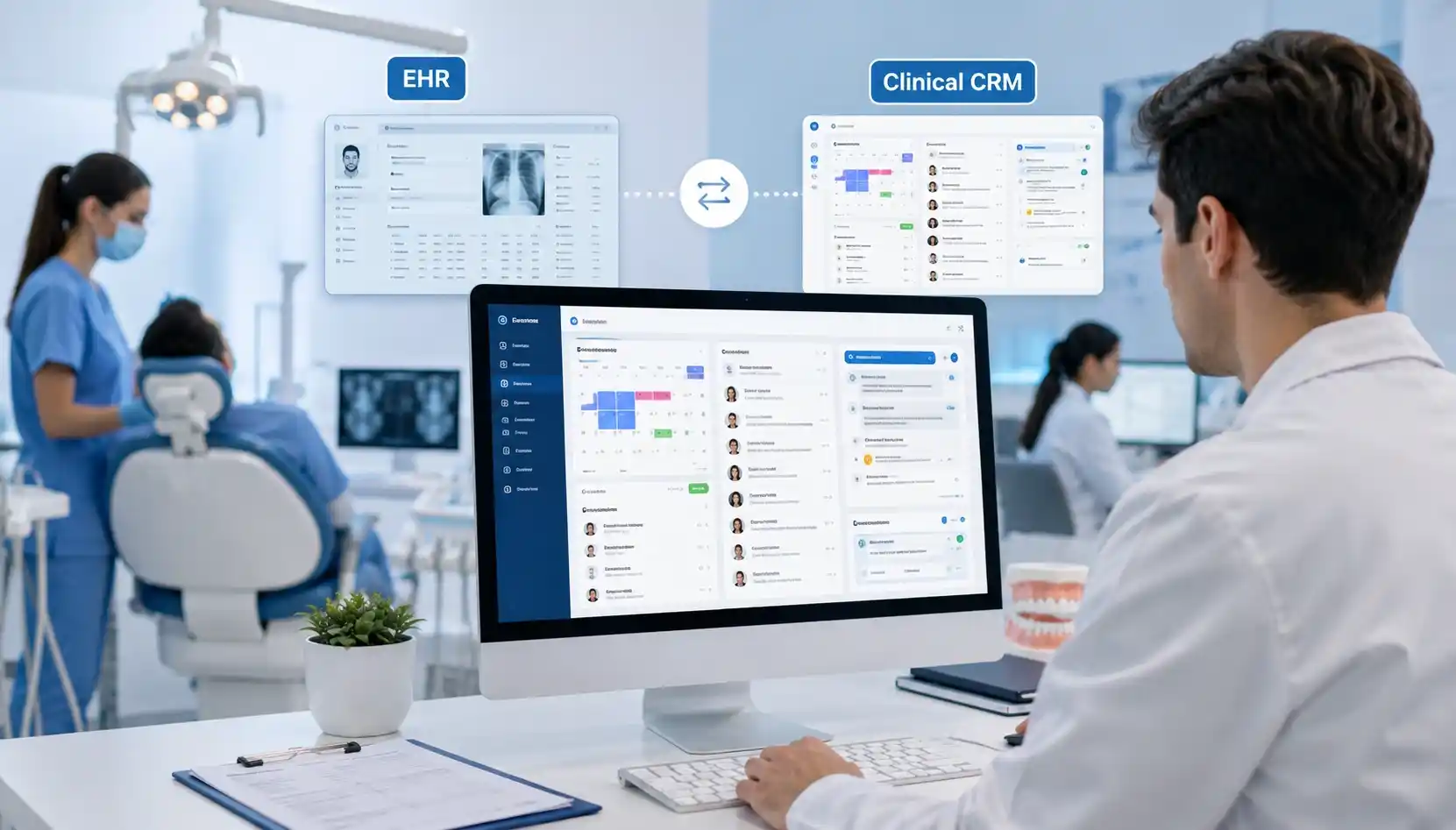
If you run a medical clinic, dental practice, or specialized health center, you are likely already paying for an Electronic Health Record (EHR) or Electronic Medical Record (EMR) system. It manages your prescriptions, clinical documentation, and billing efficiently.
However, when clinic owners look at their monthly bottom line and ask, "Why aren’t our patient schedules completely full?", the root cause is rarely clinical documentation. It is patient retention and communication failure.
While traditional EHRs excel at administrative and medical record-keeping, they were never designed to market your practice or retain patients. To drive real business growth, clinics need a dedicated Clinical CRM (Customer Relationship Management) system working alongside their EHR.
What Is the Core Difference Between an EHR and a Clinical CRM?
Traditional EHR / EMR: Built for retrospective medical documentation. It stores patient histories, doctor notes, lab reports, and billing data. It is a reactive compliance tool—it records what happened during the visit.
Specialized Clinical CRM: Built for prospective patient engagement and practice growth. It automates two-way communications, recall schedules, no-show fill-ins, and local review generation. It is a proactive marketing tool—it controls what happens before and after the visit.
Side-by-Side Comparison: EHR vs. Clinical CRM
|
Feature / Objective |
Traditional EHR / EMR |
Specialized Clinical CRM |
Direct Impact on Clinic Growth |
|
Primary Goal |
Medical documentation & compliance |
Patient retention, acquisition & revenue growth |
Drives higher patient lifetime value |
|
Communication |
One-way SMS or manual phone calls |
Automated two-way WhatsApp & SMS workflows |
Slashes appointment no-shows by up to 40% |
|
Patient Recalls |
Reactive (Relies on manual staff calls) |
Automated (Triggers 6-month checkup alerts) |
Increases repeat consultations by 50%+ |
|
Reputation Building |
None |
Automated post-visit Google Review prompts |
Dominates local Google Map Pack rankings |
|
Front-Desk Workload |
Heavy manual data entry |
Fully automated background workflows |
Frees up 100+ hours of staff time monthly |
3 Ways a Clinical CRM Drives Revenue Growth That an EHR Cannot
1. Eliminating Empty Appointment Slots with Smart Reminders
Traditional EHRs send basic, easily ignored text reminders.
A Clinical CRM uses two-way interactive messaging over channels like WhatsApp. Patients can confirm or cancel with a single tap. If a cancellation occurs, the CRM automatically alerts waitlisted patients to fill the vacant chair instantly—protecting your daily clinical revenue.
2. Automating Long-Term Patient Recalls
Patients rarely remember when their 6-month dental checkup, annual health screening, or follow-up skin treatment is due.
Because traditional EHRs don't automate outreach, these patients drift away to competitors. A Clinical CRM tracks treatment cycles automatically and triggers personalized recall messages on schedule, bringing past patients straight back into your calendar.
3. Turning Patient Satisfaction into Local Search Dominance
Generative AI search engines and Google Maps prioritize health centers with high volumes of recent, authentic reviews. An EHR does not assist with reputation management.
A Clinical CRM automatically sends a polite feedback prompt minutes after a consultation. Satisfied patients are routed to your Google Business Profile, constantly generating 5-star reviews that keep your clinic at the top of local search results.
Conclusion: You Need an EHR to Run Your Clinic, But You Need a CRM to Grow It
Relying solely on an EHR to scale your medical practice is like using an accounting software to run your marketing campaigns—it simply isn't built for that job.
If you want to stop patient drop-off, eliminate costly no-shows, and build a predictable, recurring appointment calendar, it is time to upgrade your tech stack with a dedicated Clinical CRM.
Ready to Stop Patient Revenue Leakage?
See how our healthcare-specialized Clinical CRM bridges the gap between your treatment room and patient communication.