

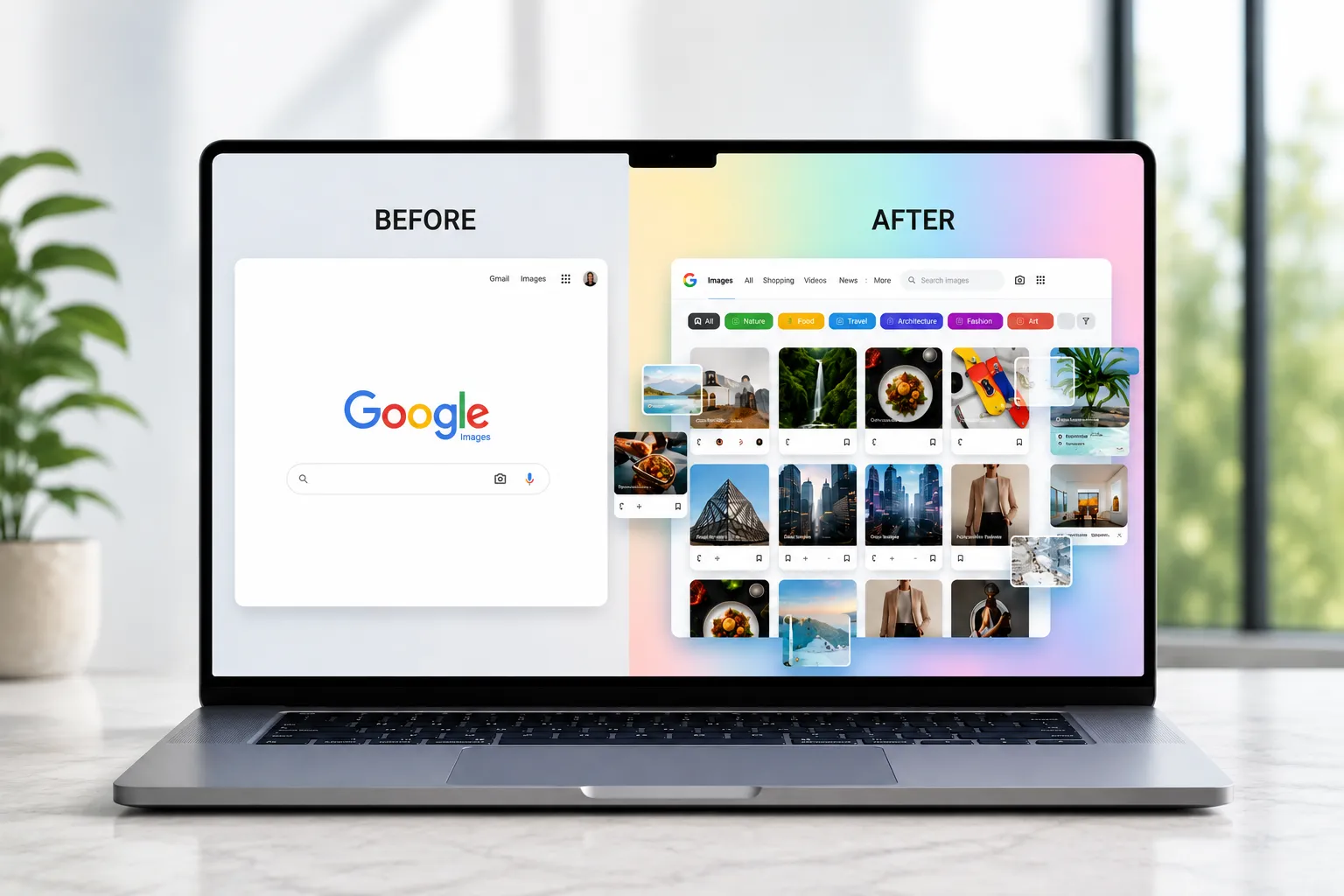
On July 14, 2026, Google Images turned 25 — and marked the occasion with its biggest redesign in years. Two changes landed the same day: a completely new, personalized Google Images homepage and AI-generated images built directly into Google Search's AI Overviews.
If your business relies on Google to bring in customers — through product photos, portfolio work or blog visuals — this Google Images update 2026 directly affects you. Here's what changed, why it matters and what to do about it.
What changed in the Google Images update 2026
1. A Pinterest-style homepage replaces the plain search box
The old images.google.com — a search bar and nothing else — is gone. In its place: a dynamic, personalized gallery of images curated in real time based on what a signed-in user has shown interest in.
Users can now save images into Collections (think mood boards for home décor, travel, fashion, events) which appear as tabs above the gallery for easy return visits.
As of launch, this redesign is available on desktop, in the U.S., in English, to signed-in users only. Google has not published a timeline for wider rollout, so businesses outside the U.S. can't act on this yet — but it's worth watching.
2. AI Overviews can now generate images instantly
The second — and bigger — change: Google Search can now create a custom image from a text prompt directly inside AI Overviews. No need to browse existing images or visit a website — Google can generate what the user has in mind, on the spot, using its own AI image model.
This is rolling out in English, across the regions that already support AI-generated images in AI Mode.
Why this matters for small businesses
The opportunity: Google Images is shifting from a search tool to a discovery feed. Businesses with strong, original visual content — real product shots, branded infographics, portfolio images — now have a new surface to be discovered on, not just searched for.
The risk: Search Engine Land specifically flagged that this could reduce publisher clicks, since more AI-generated content now lives directly inside the AI Overview itself — meaning fewer reasons for users to visit a website's images at all.
The takeaway: Generic, replaceable visuals lose ground. Original, branded, authentic images become more valuable, not less.
What to do about the Google Images update: 5 action steps
-
Identify which of your keywords are "AI-generatable." Queries like "example of X" or "what does Y look like" are the type AI Overviews can now answer without a click. Shift content toward things AI can't fabricate — real results, real locations, real proof.
-
Replace stock photos with original photography. Google has long rewarded authentic, original images with better visibility. That matters more now, since AI can generate infinite generic visuals — but not a photo of your actual product, team or store.
-
Treat your image library as a discovery channel. Visual-heavy categories — fashion, food, décor, real estate, events, hospitality — can genuinely benefit from being featured in the new browsable gallery. This is a branding opportunity, not just an SEO one. (See how we approach this in our branding services.)
-
Don't skip the SEO fundamentals. Descriptive file names, meaningful alt text, compressed fast-loading images and structured data still drive both classic Image Search and the new gallery. This is core to any Digital Marketing strategy we build for clients.
-
Track your Image Search performance in Search Console. Segment "Web" vs. "Images" search type over the next few weeks to see whether your industry is gaining visibility from the new gallery or losing clicks to AI-generated answers.
-
Google is betting that people want to browse images the way they browse Pinterest and generate images instead of always searching for them. For businesses, that's a signal, not a threat. Brands that keep investing in real, original, well-optimized visuals will show up in the new gallery. Brands leaning on generic content are the ones AI will start to replace.
Want your website's images working for you, not against you? Izh Tech helps businesses build image SEO, branding and digital marketing strategies that keep pace with Google's changes. Talk to our team and let's make sure your visuals are found — not replaced.